

Ethiopian football report card for 3 months and 8 teams – 25 games
Ethiopian football has come up with the same paper in the last three months. Eight teams, 25 games; Except for the women's Olympic team, none have yet achieved their goals. The card below shows the team-by-team results from mid-August to yesterday's Bahir Daru game; It records our wins, draws, losses, draws and ties.
Samuel Sileshi · · 6 min read · 1
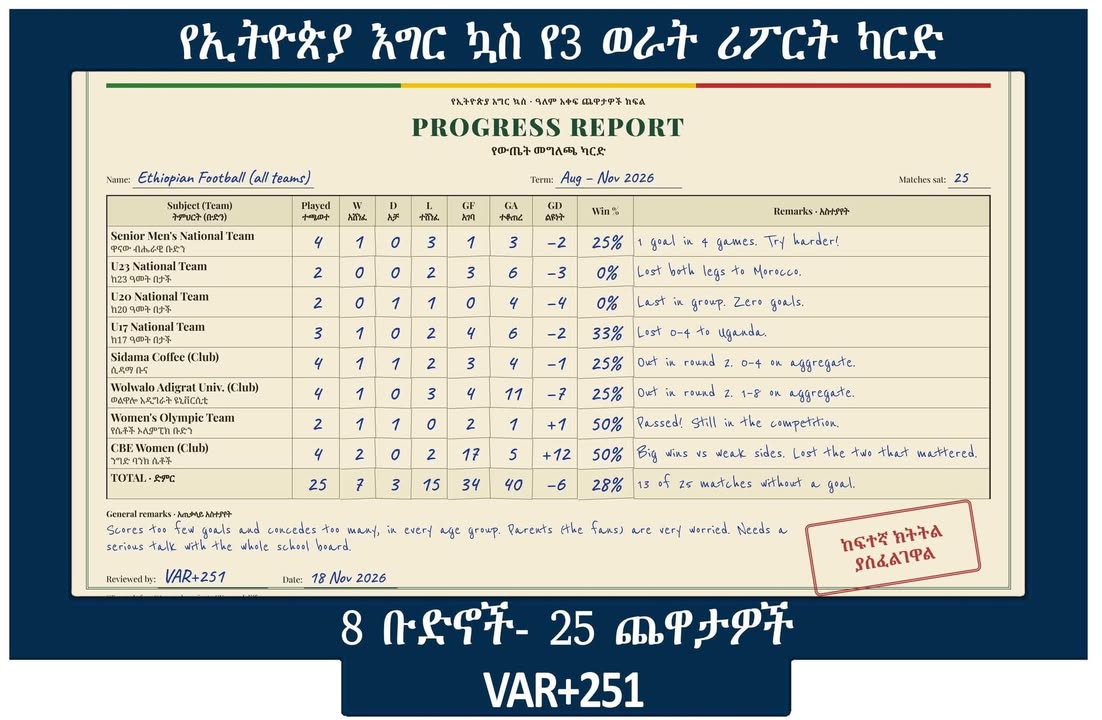
Reading numbers in a table is exhausting. But one paper we all know very well. A report card that comes home from school. A piece of paper that makes a student’s heart skip a beat when he hands it to him, and the child bows his head and waits for his parent’s answer.
Ethiopian football has come up with the same paper in the last three months. Eight teams, 25 games; Except for the women’s Olympic team, none have yet achieved their goals. The card below shows the team-by-team results from mid-August to yesterday’s Bahir Dar game; It records our wins, draws, losses, draws and ties.
There is a red seal in the corner of the card. “It needs a lot of monitoring,” he says. Read the card as a parent. Because the responsibility should not fall only on the children on the field.
The score card
From mid-August until yesterday’s Bahir Dar game, the main national team, under-23, under-20 and under-17 teams, women’s Olympic team, two men’s clubs and one women’s club represented Ethiopia on the continental stage. They all came out with one dream. Reaching the Africa Cup of Nations, qualifying for the Olympics, qualifying for the CAF Club Championship. Today, that dream is in the hands of only one group. On the women’s Olympic team.
The main team has staked its fate on the results of other fields; What he now expects is for Mozambique to lose again and again and his to win again and again. The under-23 team went through the first round not on the pitch but by forfeit; However, they fell back in front of Morocco. The under-20 team failed to finish last in the group. Under 17 team lost two out of three games.
Sidama Buna and Wolwalo Adigrat University passed the first round of the CAF club competition and when they reached the second round, they scored a total of twelve goals and were kicked out of the competition. CBE women won two games by a big margin and received applause, but they lost two valuable games and came third in CECAFA; They were left standing in front of the door of the Champions League.
All this is without counting our repeated defeats in the FIFA Under-15 World Cup and Festival competition.
The complexity of the matter is highlighted when we look at the groups we faced. Apart from Senegal, who faced the main national team, and Morocco, who faced the under-23 team, all of them are from African countries with relatively weak football. Djibouti, Sudan, South Sudan, Chad, Burundi, Rwanda, Libya, Tanzania. We have competed at this level to achieve such results.
If we take only the boys, we won 4 and lost 13 of the 19 games they played. We scored only 15 goals in 19 games and scored 34. We have a legacy of 19 goals in 19 games. This means that we will score one goal after 2.27 goals have been scored. The national team scored only 1 goal in their four games. He did not score any goals in 180 minutes at the home stadium.
This is not just a defeat on the scoreboard. It will disappoint the fans who have waited on the sidelines for years. A father who takes his child by the hand to the stadium is at a loss for words when he returns from the field. It breaks the neck of a generation that wants to go straight. And what hurts more than failure is being seen as weak. Defeats are forgotten, but reputations remain.
If we calculate the numbers with the required math, the result will only speak of our weakness. The teams we faced, the venues, the referees, the weather conditions were all different. But the result is the same. To fail, to appear weak, to appear incapable. Disappointing the people, breaking the generation’s neck, making us not stand up.
It is unbelievable to see children who have been carrying our flag for three months and come back empty-handed. But it is not only the defeat that is regrettable; Defeat has become a habit rather than news.
The players are different. The coaches, the clubs, the age levels are also different. But they have one thing in common. They all came out of the same football system. We do not believe that all this happened due to a mistake in the line-up, nor did it come from the weakness of the player switch; It’s not because the coach sits and leads or doesn’t stand and encourage; It’s not because Infantino didn’t call the president – he didn’t write a letter; All this failure is the result of a system.
Who planted the seed?
The question is no longer “Why did they lose?” is not; “Who created this system of defeat?” It says And next to him, “Who will question this system?” It will come. The fact that the people who planted the saplings, who took care of them after planting them, and continued to be the leading actors of football shows that we are preparing for another 25 games of humiliation.
Behind all this failure is a pile of unfinished homework. They are in state, city and national federation general assembly halls. The owners of this system are the ones who paved the way for anyone to come and be proud of football, the arms that are stretched high when the votes are counted in the assembly, the hands that feel like they have received the handshake, and the fingers that count the silver.
Another homework is found in the clubs offices; Grouped by nation and area, club leaders who kneel for temporary feelings instead of long-term football development, are sick of player transfers and coach hires are among the ones who created this system.
Professionals, coaches and players in the clubs are not exempt from liability; They contributed to the strengthening of this bad system because of “it is bread”.
So this 25 game, three month result is no accident; The seeds we sowed ten or fifteen years ago are the accumulated debt of the work we did not do at that time. Even if we don’t sow seeds today, the person writing ten years from now will come up with the same chart.
Conclusion
In any school, the score card does not end there. A parent signs it. However, he has not yet signed the Ethiopian football card. We never heard anyone say, “That was my responsibility.” The red seal in the corner of the card indicates the order rather than the children in the field; Because it is not the players who didn’t score, but the system that produced the player that needs “higher monitoring”.
And the monitoring should start from us, fans, journalists and experts. The Federation shall make the results evaluation report available to the public. Let’s see what the development budget is spent on. The criteria for the appointment of coaches and leaders should be announced. If we don’t ask these questions today, we’ll be reading the same numbers, maybe even worse, on the next card three months from now.
You judge.